
What is Assignment of Contract? Free Contract Assignment Template

A. What is Assignment of Contract?
Have you ever subscribed to a magazine and begun to receive another magazine midway into the subscription. This usually happens when the first company assigns its subscription contracts to another company for reasons such as closing of business. This is an assignment of contract.
In assignment of contract, one party will assign all the rights and obligations under a contract to another party. There are two parties to the assignment:
Assignor is the one who assigns the rights and obligations to other party
Assignee is the other party who gets these rights and obligations assigned.
B. When to use an Assignment Agreement?
Assignment Agreement enables a party to transfer its rights and obligations to another party. Here are some examples where an Assignment Agreement template is useful:
- Transferring Copyright / trademark / patent Assignment
- Lease - when a tenant wants to pass the lease to another tenant before lease expiration
- Debt Assignment -when you want someone else to collect the debt owed to you
- Sale of Business - when a business is sold and the contract needs to move to the new owner
Simple rule: Use an Assignment Agreement whenever you want to legally hand over your rights or obligations to another person or company.
A common example is when a business owner selling their company assigns their vendor contracts, client agreements, or lease agreements to the buyer. Another example is a freelancer who assigns a service contract to a colleague when they can no longer fulfill the work. In real estate, buyers often assign purchase agreements to other investors before closing, according to Wayne Lowry, CEO of J Wayne Lowry Consulting LLC.
C. Does the Assignor get relieved of all responsibilities under the contract once the contract assignment agreement has been signed?
Not Always, it depends on the language of the Assignment clause in the contract.
- If the Assignment Clause Guarantees Contract Performance i.e. the original party guarantees the performance of the contract regardless of the assignment of contract then the assigning party is not relieved of all responsibilities under the contract
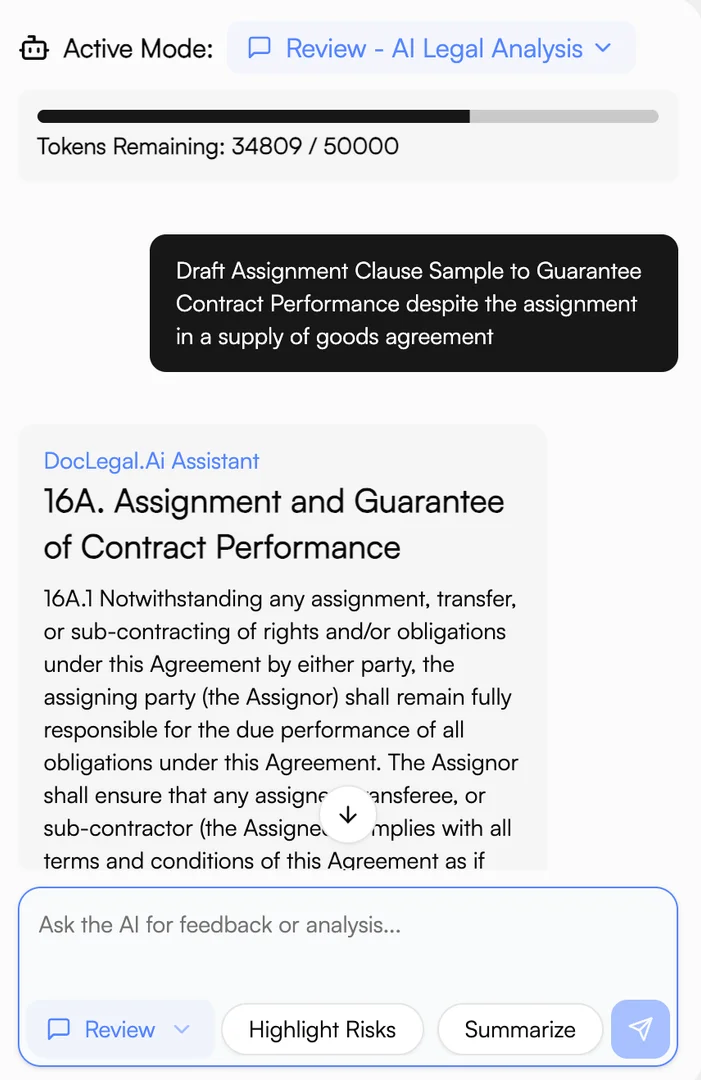
Assignment Clause Sample to Guarantee Contract Performance:
16A. Assignment and Guarantee of Contract Performance
16A.1 Notwithstanding any assignment, transfer, or sub-contracting of rights and/or obligations under this Agreement by either party, the assigning party (the Assignor) shall remain fully responsible for the due performance of all obligations under this Agreement. The Assignor shall ensure that any assignee, transferee, or sub-contractor (the Assignee) complies with all terms and conditions of this Agreement as if the Assignee were a party to this Agreement.
16A.2 The Assignor shall guarantee the performance of the Assignee and indemnify the other party (the Non-Assigning Party) against any loss, damage, or liability arising from the Assignee’s failure to perform its obligations under this Agreement.
16A.3 Any assignment, transfer, or sub-contracting under this clause shall not: (a) relieve the Assignor of its obligations under this Agreement; or
(b) result in the Non-Assigning Party having greater liability or obligations than it would have had in the absence of such assignment, transfer, or sub-contracting.
16A.4 The Assignor shall notify the Non-Assigning Party in writing of any assignment, transfer, or sub-contracting as soon as practicable, providing full particulars of the Assignee, including its name, address, and relevant qualifications or experience.
16A.5 The Non-Assigning Party shall have the right to reject any proposed assignment, transfer, or sub-contracting if it reasonably believes that the Assignee is incapable of performing the obligations under this Agreement to the required standard.
16A.6 The Assignor shall, upon request from the Non-Assigning Party, execute any agreements or instruments necessary to give effect to or perfect any assignment, transfer, or sub-contracting under this clause.
16A.7 Any assignment, transfer, or sub-contracting by the Assignor without the prior written consent of the Non-Assigning Party shall be deemed null and void.
Edit this clause in seconds with using Doclegal.ai AI Contract Review feature
- If there is Anti Assignment Clause i.e. the party is not permitted to assign any obligations under the contract unless in case of acquisition which is a common exception in assignment clause
Clause to Prohibit Assignment of Contracts Except In Case of Acquisition
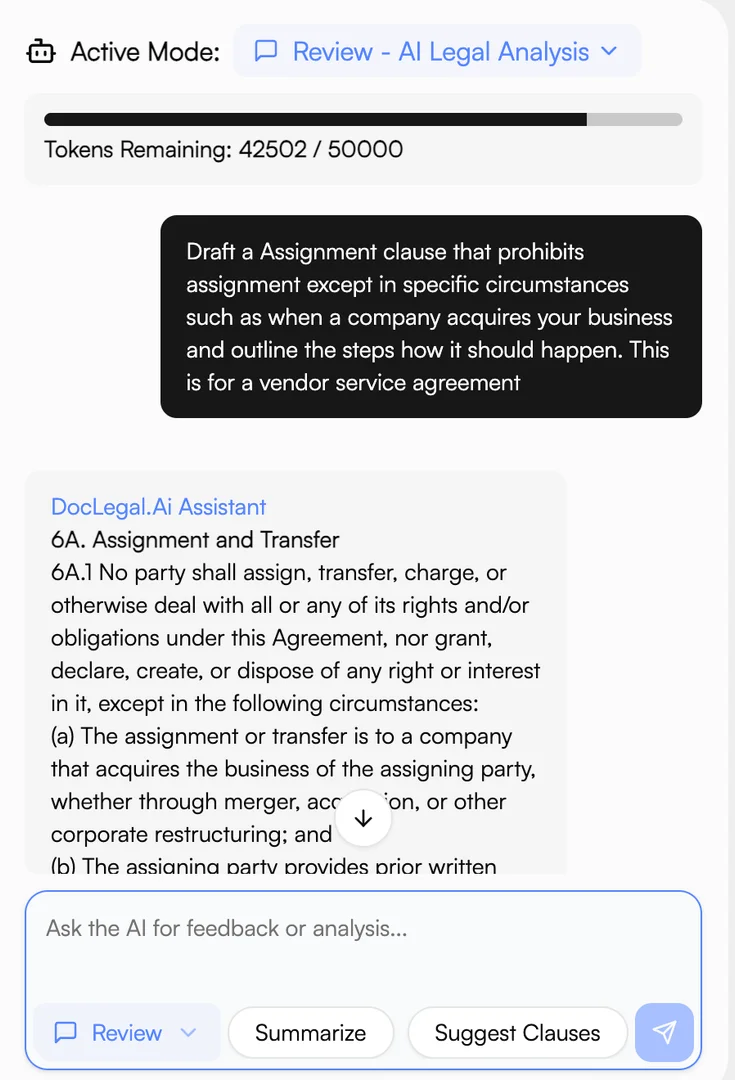
6A. Assignment and Transfer
6A.1 No party shall assign, transfer, charge, or otherwise deal with all or any of its rights and/or obligations under this Agreement, nor grant, declare, create, or dispose of any right or interest in it, except in the following circumstances:
(a) The assignment or transfer is to a company that acquires the business of the assigning party, whether through merger, acquisition, or other corporate restructuring; and
(b) The assigning party provides prior written notice to the other party, including details of the acquiring company and the nature of the acquisition; and
(c) The acquiring company agrees in writing to be bound by the terms and conditions of this Agreement as if it were an original party to it; and
(d) The other party provides its prior written consent to the assignment or transfer, such consent not to be unreasonably withheld or delayed.
6A.2 Any purported assignment or transfer in breach of this clause shall be void and of no effect.
Edit this clause in seconds with using Doclegal.ai AI Contract Review feature
- If there is an Assignment Clause to Assign Right to Receive Payment Only i.e. the assigning party can authorize another party to receive the payment but continues to be responsible for the performance of the contract
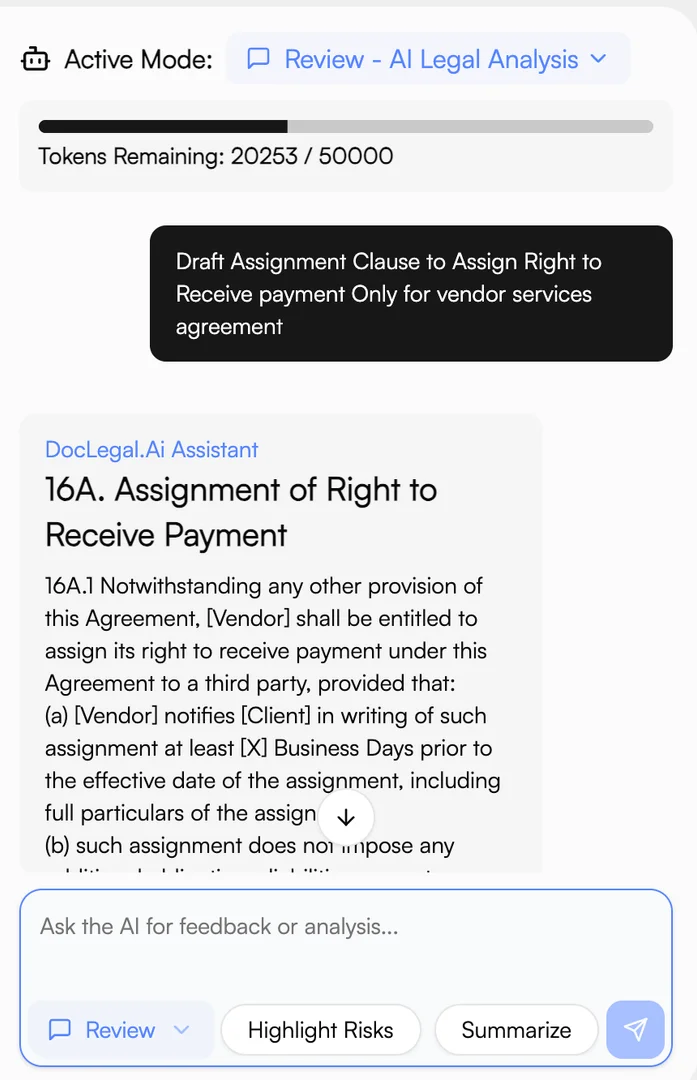
Assignment Clause to Assign Right to Receive Revenue Only:
16A. Assignment of Right to Receive Payment
16A.1 Notwithstanding any other provision of this Agreement, [Vendor] shall be entitled to assign its right to receive payment under this Agreement to a third party, provided that:
(a) [Vendor] notifies [Client] in writing of such assignment at least [X] Business Days prior to the effective date of the assignment, including full particulars of the assignee;
(b) such assignment does not impose any additional obligations, liabilities, or costs on [Client] beyond those expressly set out in this Agreement;
(c) [Vendor] remains liable for the performance of all other obligations under this Agreement and such assignment does not relieve [Vendor] of any liability for breach of its obligations under this Agreement.
16A.2 [Client] shall, upon receipt of the notice referred to in clause 16A.1(a), make all payments due under this Agreement to the assignee as directed by [Vendor], provided that [Client] has received sufficient evidence of the assignment and the assignee’s authority to receive such payments.
16A.3 [Vendor] shall indemnify and hold harmless [Client] against any claims, losses, or liabilities arising out of or in connection with any dispute between [Vendor] and the assignee regarding the assigned payment rights.
16A.4 For the avoidance of doubt, [Vendor] shall not assign, transfer, or otherwise deal with any other rights or obligations under this Agreement without the prior written consent of [Client], except as expressly permitted under this clause.
Edit this clause in seconds with using Doclegal.ai AI Contract Review feature
Sarah Garza, Real Estate Broker atLIV Sotheby's International Realty, shares her experience in real estate. "Two mistakes I see constantly: buyers assume assignment is allowed because the contract doesn't say it isn't. That's backwards — you need explicit permission. The second is not clarifying whether the original buyer stays liable if the assignee defaults. Getting that release in writing, or knowing you won't get one, changes the entire risk calculation"
D. When will the Assignment of Contract be Unenforceable?
According to Ed Hones, Attorney at Law, Hones Law Employment Lawyers, assignments cannot be enforced if they violate a law or go against a given clause in the contract. It also cannot be enforced if the assignment changes the obligations of the involved party. In case the contract involves personal skills, such as a celebrity endorsement, the assignment is not possible. The most common mistake is to assume that the Assignment is enforced because it is agreed upon. Overlooking contract clauses, wrong documentation, and assuming the shift of liability are pitfalls to avoid.
Any assignment of right and/or obligation in a contract will not be enforceable in the following scenarios:
1. The Contract Contains an Anti-Assignment Clause: If the contract expressly prohibits assignment without consent, any assignment made in breach of that clause will generally be unenforceable.
Example:
Company A enters into a services agreement with Company B. The contract states:
“Neither party may assign this Agreement without the prior written consent of the other party.”
Company A later assigns the contract to Company C without obtaining Company B’s written consent.
In this case, the assignment may be invalid, and Company B may refuse to recognize Company C as the new party to the contract.
Exception:
If the clause allows assignment in limited circumstances (e.g., to an affiliate or in a merger), and the assignment falls within that exception, it may still be enforceable.
2. The Assignment Violates Law or Public Policy: An assignment will not be enforceable if it is illegal or contrary to public policy.
Example:
- A professional license (e.g., a medical or legal license) is assigned to another person. Such licenses are personal and cannot legally be transferred.
3. The Assignment Materially Alters the Other Party’s Expectations: If the assignment significantly changes the nature of the performance or increases the burden or risk to the non-assigning party, it may be unenforceable — particularly in contracts involving personal skill, trust, or expertise.
Example:
- A celebrity chef agrees to cater a private event. The chef assigns the contract to another chef without consent. The client hired that specific chef for their reputation and style so the assignment would likely be unenforceable.
E. Assignment Checklist
- Do You want to have the flexibility to assign the tasks to another party?
- Do You Want to Prohibit delegation of any task under the contract?
- Do You Want to Permit Assignment in specific circumstances such as when a company acquires your business
- Do you want the the assignor to be continue to be responsible for the performance even after assignment
Depending on your answers, you may choose to:
- Use a broad assignment clause permitting transfer of rights.
- Include a strict anti-assignment and non-delegation clause.
- Allow assignment only with prior written consent.
- Provide that the original party remains liable unless a formal novation is executed.
You may use the appropriate Assignment Clause generated by DocLegal.ai to reflect your preferred position clearly and precisely.
F. How to Assign A Contract?
To ensure the assignment is valid and enforceable, follow these steps:
- Review the Contract Terms
- Review the assignment clause or any restrictions on assignment.
- Identify any exceptions that may allow assignment (e.g., in a business sale or merger).
- Upload your contract and ese Doclegal.ai Contract Review to understand the risks associated with the assignment clause in your contract.
- Review the assignment clause or any restrictions on assignment.
- Obtain Consent if Required
- If the contract requires the other party’s approval for assignment, get written consent before proceeding.
- Some contracts may allow assignment without consent for certain types of transfers (e.g., to a subsidiary or in the case of corporate restructuring).
- If the contract requires the other party’s approval for assignment, get written consent before proceeding.
- Determine Scope of Assignment
- Decide whether you are assigning rights only or both rights and obligations.
- Draft the Assignment Agreement
- Clearly identify the assignor (current party), assignee (new party), and the contract being assigned.
- Specify the effective date of the assignment.
- Include any warranties or assurances regarding performance.
- Clearly identify the assignor (current party), assignee (new party), and the contract being assigned.
- Include Liability Provisions
- Clarify whether the assignor remains responsible for performance after the assignment.
- Specify that the assignee will perform all obligations and comply with the contract terms.
- Clarify whether the assignor remains responsible for performance after the assignment.
- Execute and Notify
- Sign the assignment agreement in accordance with the original contract’s formalities.
- Provide written notice to all relevant parties, ensuring everyone is aware of the change.
- Sign the assignment agreement in accordance with the original contract’s formalities.
- Maintain Records
- Keep copies of the original contract, assignment agreement, and any consents or communications for future reference.
- Keep copies of the original contract, assignment agreement, and any consents or communications for future reference.
Tip: Use the Assignment of Contract Legal Doc generated by DocLegal.ai to ensure all key elements are included and your assignment is legally enforceable.
G. Free Lease Assignment Agreement Template - Edit legal doc with Doclegal.ai
THIS Lease Assignment Agreement is entered into on [Date]
Between
(1) [Party 1 Name] whose principal place of business is at [Address] (the "Assignor")
(2) [Party 2 Name] whose principal place of business is at [Address] (the "Assignee")
(3) [Party 3 Name] whose principal place of business is at [Address] (the "Counterparty")
Whereas
(A) Assignor and Counterparty entered into a lease agreement dated [Date] for the premises located at [Address] (the "Agreement").
(B) The Assignor is the current lessee of the Premises and intends to assign and transfer the Agreement to the Assignee upon the terms set out below.
(C) The Assignor wishes to be released and discharged from the Agreement and the parties have agreed to the assignment of the Agreement and to the substitution of Assignee as a party to the Agreement in place of Assignor.
It is agreed
1. Assignment
1.1 In consideration of the mutual undertakings contained in this Agreement, and with effect from the date of this Assignment (the Assignment Date):
(a) the Assignor hereby assigns and transfers to the Assignee all the Assignor's right, title, benefit and interest to, in and under the Agreement to hold the same unto the Assignee absolutely, free and clear of all mortgages, charges, pledges, liens, trusts, claims and other interests.
(b) Assignee undertakes to accept, observe, perform and discharge all the liabilities and obligations as an Assignor under the Agreement in substitution for the Assignor; and
(c) Counterparty agrees to the substitution of Assignee in place of Assignor and that Assignee shall assume and perform all duties and obligations required by the terms of the Agreement
1.2 The Assignment shall become effective on the Assignment Date and continue until the Agreement expires on [End Date]. A copy of the Agreement is attached hereto and made a part hereof by reference.
2. Further assurance
2.1 Each of the parties agrees to perform (or procure the performance of) all further acts and things, and execute and deliver (or procure the execution and delivery of) such further documents, as may be required by law or as may be necessary or reasonably desirable to implement and/or give effect to this Assignment.
3. Counterparts
3.1 This Assignment may be executed in any number of counterparts and by the parties to it on separate counterparts, each of which is an original but all of which together constitute one and the same instrument.
4. Mutual release and Indemnities
4.1 On and from the Assignment Date, each of the Counterparty and the Assignor releases the other from:
(a) any obligation or liability under or in respect of the Agreement; and
(b) any claim which it, but for this release, had or may in the future have had against the other under or in respect of the Agreement,
arising in connection with the performance of the Agreement before the Assignment Date.
4.2 Assignee indemnifies Assignor on demand against any claim, liability or loss arising from, and any costs and expenses arising out of, any act or omission by Assignee, in connection with the Agreement which occurs on or after the Assignment Date (including all legal costs and expenses).
4.3 Assignor indemnifies Assignee on demand against any claim, liability or loss arising from, and any costs and expenses arising out of, any act or omission by Assignor in connection with the Agreement which occurs before the Assignment Date (including all legal costs and expenses).
4.4 The indemnities in this agreement are continuing obligations.
5. Severability:
5.1 The invalidity or unenforceability of any provision of this Agreement shall not affect the validity or enforceability of any other provision of this Agreement.
6. Governing Law
6.1 This Assignment and the relationship between the parties shall be governed by, and interpreted in accordance with, [Jurisdiction] law.
As witness this Assignment has been signed by the duly authorised representatives of the parties the day and year above written.
Party 1 Signature
Party 2 Signature
Party 3 Signature
Customize this legal doc with AI Contract Review on DocLegal.ai
