
SaaS Agreements: Why Should You Care?
What is a SaaS Agreement: Why Should You Care?
Software as a Service (SaaS) refers to software applications hosted in the cloud and offered to customers on a subscription basis. It has become a go-to solution for many business in the United States and globally, due to its convenience and low-cost, as it allows businesses to access software without having to maintain expensive infrastructure.
This article will introduce SaaS agreements by explaining their meaning, highlighting key legal issues involved, providing SaaS agreements examples, and offering a template to guide businesses and users.
What is a SaaS Agreement
A SaaS agreement is a legally binding contract between a SaaS provider and the customer. The agreement establish the relationship between the two parties by laying out the ground rules for how the customer can log in and use the service. More importantly, the agreement define rights, obligations, and expectations regarding the software.
Why are SaaS Agreements important for your business?
As mentioned above, the SaaS agreement refers to how the software will be delivered, how it will be maintained, and how both the provider and the customer can fulfill their responsibilities.
SaaS agreements are crucial in preventing potential legal issues, setting clear service expectations, and providing a framework for dispute resolution:
For SaaS vendors, these agreements help ensure that their software is used within the agreed terms. This can effectively protect their intellectual property, and more importantly reduce liability risks.
On the other hand, for customers, a SaaS agreement ensures clear expectations around service access, privacy, and data security, safeguarding both parties from possible disputes.
What will a SaaS Agreement Typically Include?
While traditional software licenses allow customers to install and run software on their own systems, SaaS agreements operate on the premise that the software is hosted on the provider’s servers and accessed remotely. This difference introduces several unique factors:
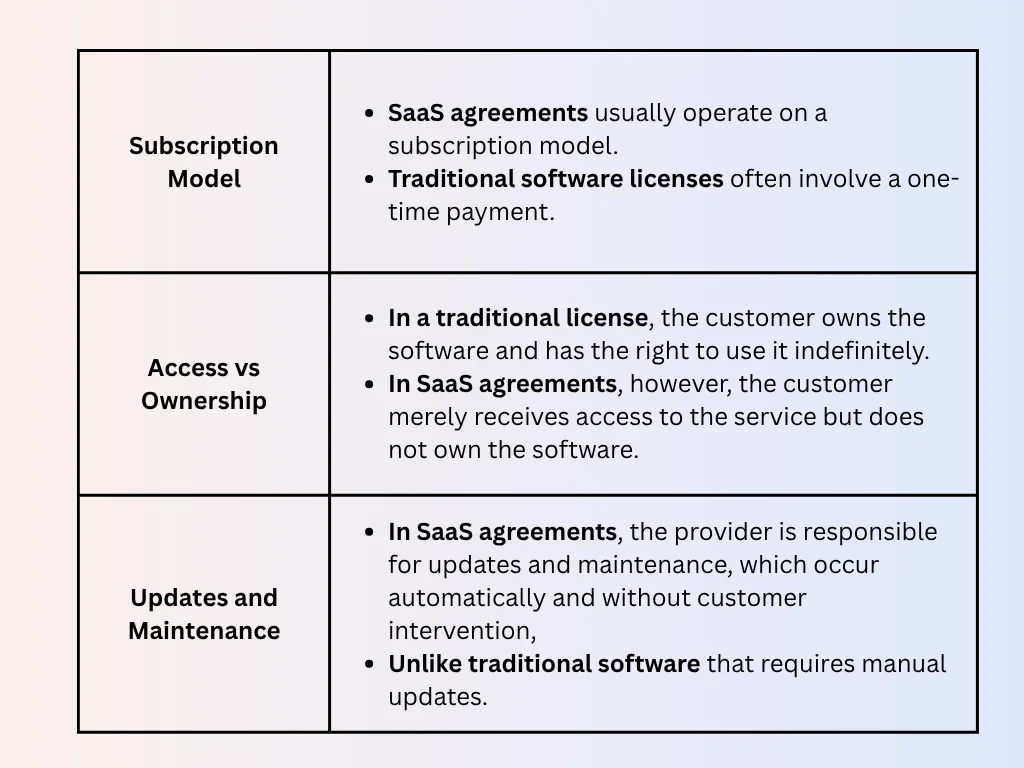
These differences mean that a typical SaaS agreement should spell out all the essentials up front, so there are no surprises down the road. These sections help prevent legal disputes and clarify the operational aspects of the service. Having a solid SaaS agreement template can ensure that all necessary details are included to avoid misunderstandings between both parties. Below are some parts you may need to include in your agreement:
1. The Responsibilities of Each Party
One of the key objectives of SaaS agreement is to outline the parties’ responsibilities to ensure a smooth business operation.
- Some of the provider/companies’ responsibilities include, agreeing to provide services in a professional and diligent manner, in compliance with all laws and regulations, etc.
- Some of the customer’s responsibilities include, registering an account via the service provided, allowing employees and other third parties to access the software and service, and promptly notify the provider if there’s any breach, etc.
2. Restrictions
Restrictions are mainly a part designed to stop unauthorised use of the services. For example, customers may not:
- Copy the software, service or documentation,
- Reverse engineer, disassemble, decompile, attempt to discover the source code or the object code or any algorithms and know-how relating to the services or the software,
- Remove, modify, or obscure any copyright, trademark, or other proprietary notices contained in the software used,
- And so on.
3. Payment Terms
This is where both parties should detail when, how, and how much should be paid. For example:
- Customers shall pay fees to the provider in instalments from the effective date; if the customer does not pay within 15 days after the invoice date, a late payment charge of 5% per month will be due
- The fees exclude goods and services tax, value-added tax or any other applicable taxes
- Customers shall pay the fees to provider by such payment method agreed by the provider in writing
- And so on.
4. Customer Data
As privacy and data protection are becoming increasingly important, it is worth spending more time on this section to outline all the responsibilities of both parties. For example:
- The Customer owns and accepts all responsibility for any data, information or material that the Customer and its users process or submit to the Service in the course of using the Service, including any personally identifiable information.
- The Customer agrees to separately back up all Customer Data.
- And so on.
Now you are Ready to Draft it. What are Some Points to Note When Negotiating?
While SaaS agreements help protect both parties, they must also address various legal issues to ensure compliance with local and international laws. Here are some of the most important legal issues in SaaS agreements that both parties should pay attention to:
Data Privacy and Protection Requirements
- SaaS agreements legal issues often involve how customer data is handled, especially considering the growing importance of data protection laws like GDPR (General Data Protection Regulation) and CCPA (California Consumer Privacy Act).
- Compliance with these regulations is crucial, and the agreement should specify how data will be collected, processed, stored, and protected, outlining the steps the provider will take to ensure compliance with data protection laws.
Cross-Border Data Transfer and Storage
- As SaaS products are often used globally, data frequently crosses borders.
- The SaaS agreement must specify how these cross-border data transfers are handled, ensuring compliance with international data protection laws, especially for customers in countries with stringent data privacy regulations.
Vendor and Customer Obligations
- The SaaS agreement must clearly outline the obligations of both the vendor and the customer.
- This includes uptime guarantees, customer support expectations, and data protection responsibilities.
- It should also specify the customer’s obligations in terms of payment, data accuracy, and compliance with usage restrictions.
Managing Cybersecurity Risks and Breach Notification
- Cybersecurity is a key concern in SaaS agreements legal issues.
- The agreement should define the provider’s obligations to maintain a secure environment and outline what happens if a data breach occurs.
- It should also detail how the provider will notify the customer in case of a breach and what remedial actions will be taken.
Intellectual Property and Ownership Disputes
- SaaS agreements need to clearly define the ownership of the software, data, and any customizations made to the service.
- Intellectual property (IP) rights should be explicitly stated to avoid confusion or disputes over who owns the software or any data generated by its use. Click here to see how IP rights can be very important to your business success.
Risks of Non-Compliance and Potential Penalties
- Non-compliance with regulations like GDPR can lead to substantial fines.
- The SaaS agreement should specify how both parties will manage compliance obligations and what penalties may arise in case of a breach, particularly with respect to data privacy and intellectual property.
What about AI Features in SaaS Agreements?
There are some particular things to note when negotiating and reviewing a SaaS agreement that includes AI features or gen-AI, because there are unique risks associated with AI. For example, risks around data training, unpredictable outputs, IP ownership, regulatory compliance, and liability that go beyond standard SaaS terms (e.g., uptime SLAs, basic data privacy).
Therefore, negotiations should be risk-based: tailor terms to the AI’s use case (low-risk chatbots vs. high-stakes decision-making tools). Use a clause-by-clause review, map data flows, and consider a data processing addendum or AI-specific schedule. You should, including but not limited to:
- Clearly define the scope of AI services: explicitly describe what the AI does (e.g., workflows, decisions, etc.), avoid vague terms like “predictive” or “intelligent.”
- Outline data ownership, usage rights, and training restrictions: prohibit the provider’s use of your data for training their models, demand data portability in structured format and certified deletion.
- Pay attention to intellectual property rights and indemnification: secure broad commercial licenses to use AI-generated outputs, require vendor indemnity for third-party IP infringement claims arising from their training data or your use of outputs, and push back on broad disclaimers that outputs may infringe IP.
- Ensure privacy, security, and regulatory compliance: require full compliance with applicable laws, address AI-specific risks (e.g., prompt injection, data leakage, etc.); include a change-in-law clause for new AI regulations.
- Additional best practices: conduct due diligence on vendor’s AI practices, align with your internal AI governance policy (responsible use, human oversight, and so on), consider a separate AI addendum or schedule for clarity.
Do you need a lawyer to Draft SaaS Agreements?
Generally no. There are many reliable SaaS templates online. As long as you pay attention to the aspects mentioned above and make sure to maximize your interest, using templates will be just as effective. Below is a checklist of things you should consider:
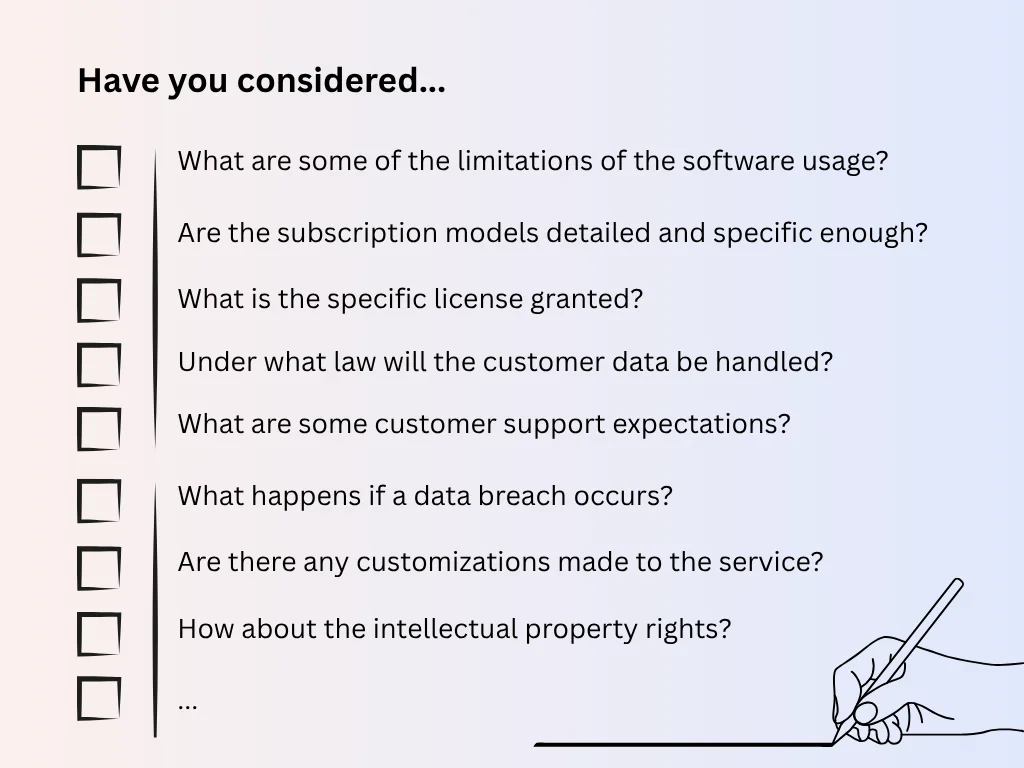
In addition, there are many legal AI tools on the market that can help. If you want to ensure your SaaS agreement is legally binding, effective, and tailored to your specific business needs, DocLegal.AI is here to help. As an AI-powered generation tool, DocLegal.AI allows you to create customized SaaS agreements and other legal documents with ease, ensuring that you’re always compliant and protected. Please see here for a SaaS agreement template and how DocLegal may help.
