
Shareholder Agreement For A New Company in 2026
Shareholder Agreement For A New Company in 2026
A Shareholder Agreement is a legally binding contract between the shareholders of a company that defines their rights, responsibilities, obligations, sets out how the business is managed, and provides framework for resolving disputes
Shareholders in a startup are typically the founders, early-stage investors, and equity holding employee. These stakeholders have different objectives: founding members need operational autonomy, efficient decision making without being blocked in the event of sale, and minority shareholders need contractual protections to prevent majority abuse.
A shareholder agreement pre-emptively addresses key issues: share transfer, decision making deadlocks and shareholder exit process thereby ensuring all shareholders are legally aligned from the beginning.
We provide a lawyer vetted Shareholder Agreement that you can customize with AI legal document generator.
Download Shareholder Agreement Template
What is the Purpose of a Shareholder Agreement?
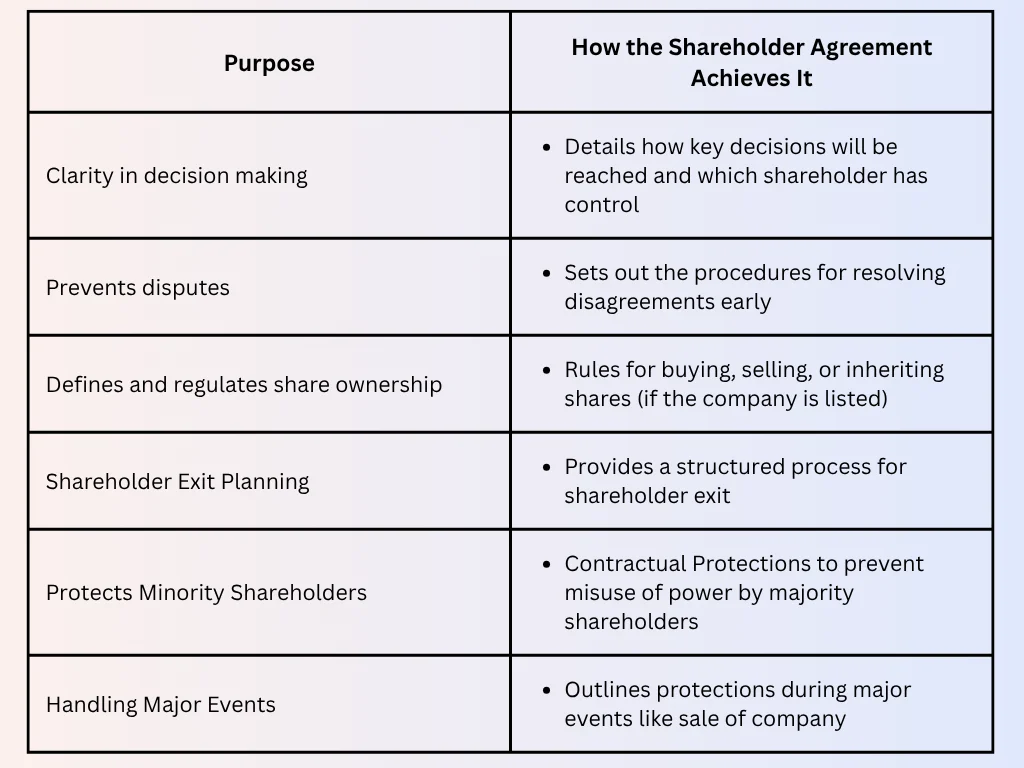
The purpose of a shareholder agreement is to clearly set out how the company is owned, managed, and controlled while providing contractual protections to all the shareholders.
It typically addresses critical questions such as:
- How key decisions will be reached
- Rules for buying, selling, or inheriting shares (if the company is listed)
- Procedures for resolving disagreements
- Protections during major events like an owner’s departure or the company’s sale
Who are the parties to a Shareholder Agreement?
A shareholder agreement can be entered between:
- Founders and Key Investors
- All the shareholders or just some of them
- The company itself is sometimes joined as a party to the shareholder agreement
- Employee Shareholders, if applicable
All shareholders can be party to the shareholder agreement and the terms of the agreement distinguishes between the majority, minority and investor shareholders by allocating their respective rights and obligations
When Does Your Startup Need a Shareholder Agreement?
- Two or More Founders holding shares and need to define what happens if one person stops contributing
- 50/50 Ownership and need a process to resolve deadlock in decision making
- Friends and Family are the first investors in your company and they need specific oversight and exit rights
- Exit or buy-out Strategy is required to cover future scenarios of a founder leaving, selling shared
When to Put the Agreement in Place?
- At company formation
- When adding co-founders
- Bringing in new investors
- During significant growth phases or ownership changes
What to Include in the Shareholder Agreements?
- Share Capital and Ownership Structure: Define shareholder percentages and set rules for issuing new shares, future capital contribution
- Company Governance: includes board composition, appointment rights, and removal of directors and meeting quorum requirements for board and shareholder meetings.
- Voting rights: Voting rights for all shareholders, identify reserved matters requiring supermajority, shareholders with veto rights.
- Financial Matters: establish the Dividend policy, profit distribution and Funding mechanisms (e.g., capital calls, shareholder loans).
- Share Transfer: imposes restrictions on share transfers, including right of first refusal or pre-emptive rights
- Exit Provisions: Tag-along rights for minority protection in sales and drag-along rights to have the minority shareholder to join a sale, Vesting schedules, compulsory buy-outs on specific triggers such as death, disability, bankruptcy, divorce.
- Dispute and Deadlock Mechanisms: Procedure for resolving disputes and deadlock between shareholders
- Termination: Lists events triggering termination of the agreement.
What are Some Key Advantages of Shareholder Agreements?
- Dispute prevention: Pre-agreed rules on authority and resolution methods minimize costly arguments.
- Seamless crisis management: Buy-sell provisions and preset valuation methods ensure shares can transfer smoothly in cases of death, disability, or insolvency.
- Minority shareholder safeguards: Features like information rights, veto powers on major issues, and tag-along protections prevent majority owners from sidelining others.
- Support for future funding: Pre-emptive rights give current shareholders priority when new equity is issued, helping maintain proportional ownership.
- Clear exit pathways: Drag-along rights and defined timelines reduce deadlock risks during sales or ownership changes.
Shareholder Agreement Templates on Doclegal.ai
- Shareholders Agreement - Equal Shareholdings: is suitable for the set up of a relatively simple joint venture - a company with equal shareholding. This shareholders' agreement is drafted for 2-5 parties. It can be in Neutral / Strict / Loose Form.
- Shareholders Agreement - Unequal Shareholdings: to be entered into upon completion or establishment of the Joint Venture Company with standard clauses for minority protection. This shareholders' agreement is drafted for 2-5 parties. It can be in Neutral Form / in favour of the Majority / Minority Shareholder.
Frequently Asked Questions For Shareholders Agreement
Can I bring a new shareholder into the company after signing a Shareholder agreement? yes, review the shareholder agreement for restrictions, use Doclegal.ai to generate a Deed of Accession, and get it signed.
Can a director be a party to the shareholder agreement? a director signs the shareholder agreement only if they are also a shareholder.Directors do not sign in their capacity as directors unless they hold shares or assume additional contractual obligations.
When is a shareholder agreement usually signed? It is typically signed at the incorporation stage or when new shareholders or investors join the company, to ensure ownership and control terms are clearly defined from the outset.
Can I trust Doclegal.ai shareholder agreement for my company? Yes, the shareholder template are vetted by lawyers. Doclegal.ai is the best value AI legal tool and does not require prior legal experience to use the legal templates. Just provide your scenario and generate the shareholder agreement in minutes
Shareholder Agreement for Freelancers, Creative Agencies, and Family-Owned Ventures
Because every business is unique, a one-size-fits-all SHA rarely works. Different business models, such as early-stage startups, project-based teams, creative firms, or multi-generational enterprises, face distinct challenges. Below, we introduce four common types of tailored shareholders’ agreements and highlight their primary purposes and key clauses.
Key Provisions for Shareholder Agreement for Freelancer:
Freelancer-focused shareholders' agreements arise when independent contractors form collectives, joint ventures, or equity-based partnerships
- Contribution-based equity and profit sharing: Ties ownership or distributions to billable hours, client wins, or deliverables
- IP ownership and licensing: Critical for freelancers; specifies who owns work product per project, with licenses granted to the company while allowing freelancers to retain portfolios or reuse non-exclusive elements. For a detailed guide on how to protect the IP,
Key Provisions for Shareholder Agreement for creative agencies / advertising agencies
- Creative control and client protections: Grants specific partners veto rights on creative decisions or client assignments; includes strong non-solicitation and non-compete clauses to prevent poaching clients or talent.
- IP and portfolio rights: Clarifies ownership of agency work, client deliverables, and reusable creative assets.
Key Provisions for Shareholder Agreement for Family-Owned Ventures
- Succession planning and leadership transition: Outlines how leadership and ownership pass to the next generation, including training requirements or performance benchmarks.
- Buy-sell and transfer restrictions: Mandatory or optional buy-outs triggered by death, disability, divorce, or voluntary exit; strong pre-emption rights and ROFR to keep shares in the family.
- Dividend policy and capital contributions: Balances reinvestment for growth with family income needs; may include rules for loans or guarantees from family shareholders.
How Doclegal.ai Creates Shareholder Agreements
Get instant access to lawyer-reviewed, AI-customizable Shareholders’ Agreement templates:
✅ Tailored clauses for your exact situation
✅ Ready in minutes, not weeks
✅ Starting at just $2.5 per document (or from $10/month)
Protect your shares, prevent disputes, and align everyone from day one.
👉 Create Your Shareholders Agreement Now on DocLegal.ai
