
Guide to Drafting SaaS Agreements (2026 Template Included)
Guide to Drafting SaaS Agreements (2026 Template Included)
SaaS agreements are essential for the business, but there are many different types of SaaS agreement - which one to choose? SaaS agreements can vary depending on the scale of the business and the nature of the service. This article is a guide on how to choose the template that best suits your business.
What are some of the commonly used SaaS agreement templates?
Whether you use doclegal.ai or search online, you may ultimately find mainly four different types of SaaS agreement templates. These four types of templates are:
- Core SaaS/Cloud Service Agreement (CSA)
- Master Service Agreement (MSA)/Broad Products & Services Agreement
- Partner/Reseller/Channel Agreement
- Standard Subscription Agreement (often used as ToS-style or simple MSA for recurring subscriptions)
We will walk you through the differences between these four below, including the key characteristics of each and when they are best used for.
Core SaaS/Cloud Service Agreement (CSA)
This template is best for standard direct SaaS subscriptions (self-serve or sales-led).
The key characteristics of CSA is that it ensures pure access to hosted software + platform. It has strong restrictions on use, IP ownership stays with Company, "as-is" disclaimers, and customer data ownership.
Master Service Agreement (MSA)/Broad Products & Services Agreement
This template is best for complex B2B deals involving SaaS + Professional services (development, consultancy, integration).
It covers Licensed Software, Developed Software, Consultancy Services, Systems Integration, Acceptance Tests, detailed IP, warranties, indemnities. It is heavy on project deliverables and appendices.
Partner/Reseller/Channel Agreement
This template is best for indirect sales through resellers, distributors, or channel partners.
Such a template grants resell rights in a territory, End User License Agreements (EULAs), commission/fee structure, marketing obligations, non-compete.
Standard Subscription Agreement
This template is best for recurring end-user subscriptions, especially for SMB or product-led growth.
These kinds of templates focus on service plan, subscription fee, auto-renewal, trial periods, basic restrictions. It is very subscription-centric with clear termination and payment terms.
Step-by-step guide to choosing the right SaaS agreement template
In order to make sure a correct template is selected, it is useful to ask yourself these five questions, from one to five, in order:
- Who is the other party in the Saas Agreement?
- Is this pure SaaS access, or are you also providing development, implementation, or consultancy?
- What is your go-to-market model?
- What is your deal size and complexity?
- What are your compliance needs?
Who is the other party in the Saas Agreement?
- If the other party is direct end-user or customer of business, please use the CSA or Standard Subscription Agreement
- If the other party is channel partner/reseller/distributor, please use the Partner/Reseller/Channel Agreement
- If the other party is an enterprise customer who needs custom work, integration, or consultancy, please use the MSA agreement.
Is this pure SaaS access, or is the business also providing development, implementation, or consultancy in Saas Agreement?
- If it is pure Saas access, please use CSA or Standard Subscription Agreement
- If there is any need for professional services or custom development, use MSA agreement
What is the business’s go-to-market model?
- If your business is product-led, self-serve, high-volume, please use Standard Subscription Agreement or a click-wrap version of CSA agreement
- If your business is a sales-led enterprise, please use MSA agreement
- If your model is indirect or channel sales, please use Partner/Reseller/Channel Agreement
What is Saas deal size and complexity?
- If the deal is small or a standard subscription, please use Standard Subscription Agreement as this is the simplest
- If the deal involves complex requirements, please use the CSA agreement
- If the deal involves large enterprises or multi-phase projects, please use the MSA agreement.
What are the Saas agreement’s compliance needs?
- It is worth noting that all the templates should be customized to adapt to their jurisdictions
- However, if you need strong data protection, SLAs, or DPA addendums, then choosing MSA or CSA agreements are easier to extend. Usually, they already have service level terms and technical support schedules.
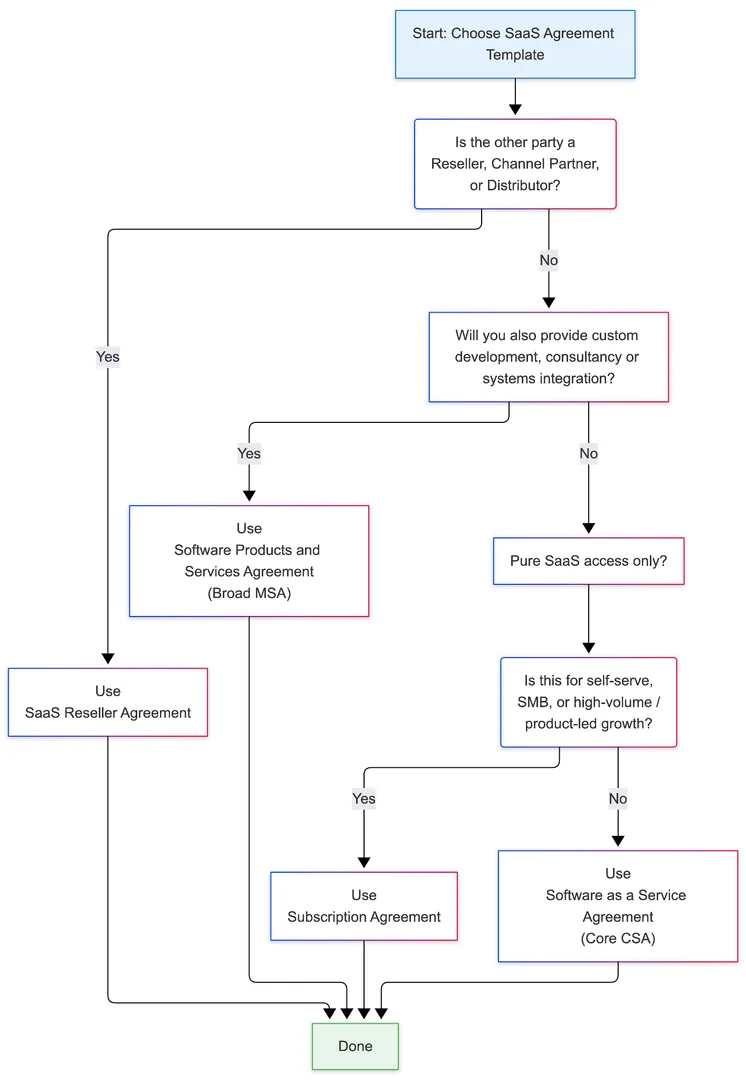
Below is a flowchart to assist in making a decision:
SaaS Agreement Template 2026
Creating a SaaS agreement template from scratch can be time-consuming and challenging. Using a template can ensure consistency and legal protection, helping businesses quickly draft agreements that cover all essential legal aspects.
For illustration purposes, below is a template about the most commonly used SaaS agreements, the Core SaaS/Cloud Service Agreement (CSA).
Rest of the templates mentioned can be found on Doclegal.ai.
----------------------------------------------
Last Updated: [Date]
This Software as a Service (SaaS) Agreement (“Agreement”) is entered into on [Effective Date] by and between:
[Vendor Name], a [State/Country] corporation with its principal office at [Address] (“Vendor”); and [Customer Name], a [State/Country] corporation with its principal office at [Address] (“Customer”).
1. Purpose
The purpose of this Agreement is to outline the terms and conditions under which the Provider will offer access to the software product described below to the Customer.
2. Definitions
For the purposes of this Agreement:
“Software” refers to the software application provided by the Provider and hosted on the Provider’s servers, which the Customer may access via the internet.
“Subscription” refers to the Customer’s right to access and use the Software for a specified period, typically [monthly/annually], as outlined in the Payment Terms below.
3. Scope of Service
The Provider agrees to provide the Customer with access to the following Software: [Software Name].
The Software will be made available to the Customer via the internet on a cloud-based platform hosted by the Provider.
The Provider will ensure that the Software is accessible [99.9%] of the time, excluding scheduled maintenance or downtime due to unforeseen technical issues.
4. Subscription and Payment Terms
Subscription Fee: The Customer agrees to pay a subscription fee of [Subscription Fee Amount] per [month/year] for access to the Software.
Payment Method: Payments will be made via [Payment Method, e.g., credit card, bank transfer].
Billing Cycle: Payments will be invoiced [monthly/annually] in advance and are due by [due date].
Late Payment: Any payments not received by the due date will incur a [Late Fee Percentage] late fee.
Renewal: This Agreement will automatically renew for subsequent [monthly/annual] periods unless either party provides written notice of termination at least [Notice Period] days before the renewal date.
5. Data Privacy and Security
The Provider agrees to comply with applicable data protection laws, including [Data Protection Law, e.g., GDPR, CCPA].
The Provider will take reasonable measures to protect the Customer’s data and prevent unauthorized access.
The Customer acknowledges that they own their data, and the Provider will only use it for the purposes described in this Agreement.
6. Intellectual Property
The Provider retains ownership of all intellectual property rights related to the Software.
The Customer is granted a limited, non-transferable, non-exclusive license to use the Software during the term of this Agreement.
The Customer may not modify, reverse engineer, or sublicense the Software.
7. Support and Maintenance
The Provider will provide technical support during normal business hours via [Support Method, e.g., email, phone, live chat].
The Provider will also perform necessary updates and maintenance to ensure the Software functions correctly. Scheduled downtime will be communicated to the Customer in advance.
8. Limitation of Liability
The Provider’s liability under this Agreement will be limited to the total amount paid by the Customer for the Software in the [12-month] period preceding the event causing the claim.
The Provider will not be liable for any indirect, incidental, or consequential damages, including loss of profit, arising from the use of the Software.
9. Termination
Either party may terminate this Agreement by providing [Notice Period] days’ written notice to the other party.
Upon termination, the Customer’s access to the Software will be revoked, and the Customer agrees to remove any copies of the Software from their systems.
The Customer may request the return of their data, which the Provider will provide in a standard format within [Data Return Period] days of termination.
10. Miscellaneous
Governing Law: This Agreement will be governed by and construed in accordance with the laws of [Jurisdiction].
Dispute Resolution: Any disputes under this Agreement will be resolved through [arbitration/mediation] in [Location].
Force Majeure: Neither party will be held liable for failure to perform due to circumstances beyond their control, such as natural disasters or governmental actions.
IN WITNESS WHEREOF, the parties have executed this SaaS Agreement as of the Effective Date.
[Provider Name]
By: ___________________________
Name: [Your Name]
Title: [Your Job Title]
Date: _________________________
[Customer Name]
By: ___________________________
Name: [Customer Representative Name]
Title: [Customer Representative Job Title]
Date: _________________________
----------------------------------------------
Final Recommendation of Choosing the Correct SaaS Template
- The most versatile starting point for most modern SaaS companies is the CSA agreement. It is clean, modern, and focused purely on cloud access.
- You can also use Standard Subscription Agreement if you want an even simpler, subscription-heavy version for smaller customers or self-serve sign-ups.
- Use MSA agreement only when you are bundling significant professional services.
- Use Partner/Reseller/Channel Agreement exclusively for your reseller/channel program.
Need Help Drafting Your SaaS Agreement?
Still have doubts which one to choose? All the templates mentioned above can be found on Doclegal.ai, which contains lawyer-reviewed SaaS agreement templates.
Apart from assisting in drafting your SaaS agreement, Doclegal.ai also offers a contract review feature, where you can easily upload other SaaS contracts to the system, and the AI chatbot will review the contract and highlight the high risk provisions in the contract.
For instance:
- Limitation of Liability: The SAAS vendor limited their liability to a maximum of $5,000 regardless of damages even if a platform failure caused significant business disruption or data loss.
- One-sided Indemnity Clause: The contract had a unilateral indemnity provision requiring the customer to indemnify the vendor only.
If you drafted a SaaS agreement, DocLegal.ai also offers smart recommendations to revise the language. By using it's ‘revise clause’ feature, you will be able to:
- Increase the liability cap
- Add specific protections for data loss and business interruption.
- Make the indemnity clause mutual rather than one-sided.
To learn more about how DocLegal.ai simplifies the review and negotiation of SaaS agreements, visit DocLegal.ai. Get started with DocLegal.AI today and streamline your legal document creation process, limited offer awaits!
