
Employee Separation Letter Guide For 2026

Employee Separation Letter Guide For 2026
Morgan Stanley lays off 2500 employees across its major divisions. The affected employees now will undergo a separation process guided by the HR policy of Morgan Stanley
The affected employees will receive an employment separation notice or termination letter, which serves as a form record of the separation and provides guidance on the next steps including the rights and responsibilities of the employee.
This guide provides information on the employee separation letter, covering the types of employment separation, essential requirements, and employee separation letter template you can use and customise today
What is a Separation Letter for an Employee?
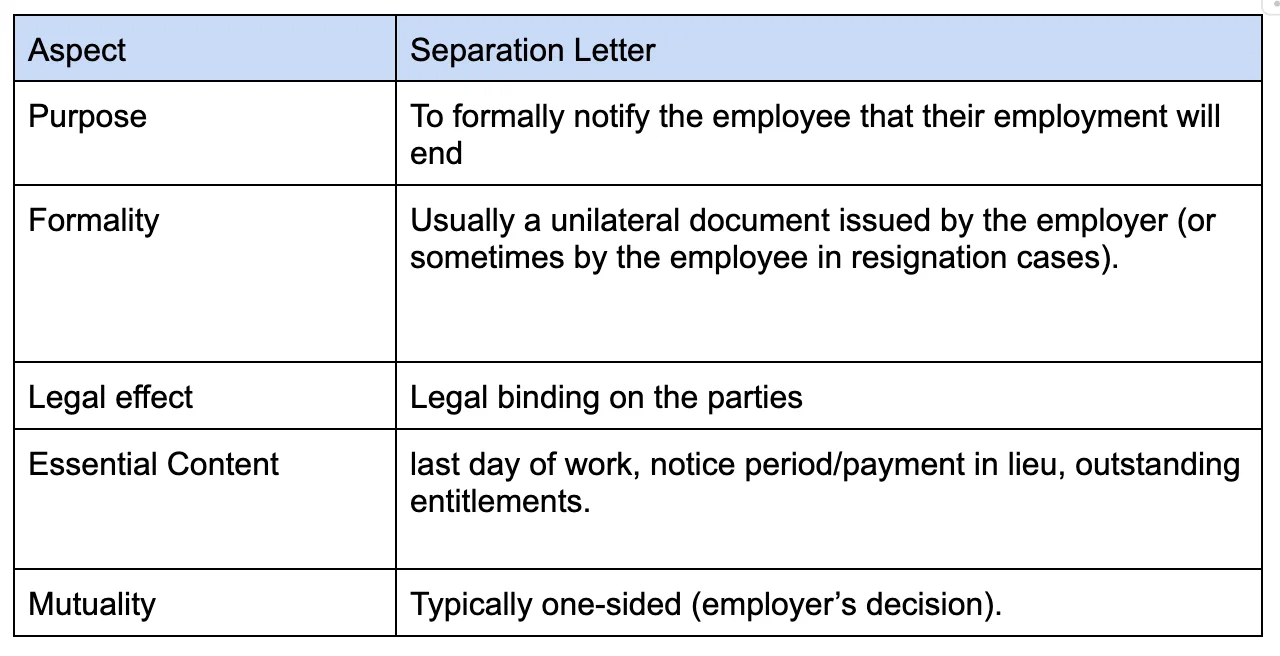
A separation letter for an employee is a formal notice that is issued by the employer to confirm the end of an employment relationship. It provides a record of the:
- Last day of employment
- Reason for separation
- Final paycheck details and benefits
- Instructions for returning company property
- Acknowledgement by Employee
Two Types of Employment Separation
There are two types of Employment Separation: Voluntary and involuntary Separation of Employee
Voluntary Employment Separation : Voluntary separation occurs when the employee self chooses to end the employment. This process is self initiated by the employee.
Common forms of voluntary employment separation are: employee resignation, retirement, choosing not to renew a fixed term contract.
The key document in voluntary employment separation is the written resignation letter from the employee, which acts as a record that the termination was self initiated rather than fired or forced out by the employee.
Involuntary Employment Separation: Involuntary separation occurs when the employer makes the decision to terminate the employment. This process is initiated by the employer on the following two grounds:
- Termination of Employment For Cause (Poor Performance or Misconduct)
This occurs when an employee has failed to meet the expected performance standards or has violated the company policy (e.g. harassment etc.)
- Termination of Employment Due to (Restructuring, Layoff, Redundancy)
The employee is dismissed by providing a required notice or payment in lieu of notice without needing a specific reason for termination This occurs when an employee is no longer needed due to downsizing or restructuring.
When is a Separation Letter Required?
Employer must issue a separation notice or separation letter to the employee in the following situations
- Resignation - confirm the final working day and notice period
- Lay off
- Mutual Separation
- Termination for reasons such as poor performance, misconduct etc
My client in sustainability business in Hong Kong had the most commonly asked employee separation enquiry:
“One of our employees has significant skill gaps, poor collaboration with the team, and has entered a ‘complaint loop’ where every resolved grievance was immediately replaced by a new one, consuming all of management's time without any performance improvement. We need guidance on employee separation.”
(a) Is it okay to skip the Performance Improvement Plan and request a "Mutual Separation"?
My response: Yes, it is legally permissible to skip the PIP and propose a mutual separation, but the process must be consensual and well-documented to avoid later disputes.
A “mutual separation” is essentially a termination by mutual agreement, often documented in a settlement agreement. If properly executed, it can validly end the employment without following a PIP process. The key is that the employee must genuinely agree to the arrangement, and for the employer to prepare a mutual separation agreement covering:
- Last day of employment
- Final payments (including accrued entitlements)
- Waiver of claims
- Confidentiality and return of company property
(b) Does the employee need to serve a notice period if we agree on mutual separation?
My response: The parties can mutually agree to waive notice entirely.
- If parties mutually agree to waive, no notice is required.
- If the parties do not agree to waive the notice period, then the contractual / statutory notice period applies.
How to write a Separation Letter?
1. Before Drafting, key Legal Considerations for Employee Separation Letter are:
- Check the employment contract and confirm the notice period and termination provisions
- Avoid unlawful dismissal i.e. ensure the reason for termination is not prohibited (e.g., pregnancy, paid sick leave, trade union activities).
- Ensure compliance with local law requirements (e.g. final wages and statutory entitlements)
2. To be valid and reduce dispute risk, the employee separation letter template should clearly cover:
- Date of the letter
- Employee’s full name and position
- The statement of termination i.e. clearly states that the employment will end.
- Specify Last working day
- Specify the Notice period or payment in lieu: state whether notice is being served or wages in lieu will be paid (as per contract or statutory minimum).
- Final payments: mention that outstanding wages, accrued annual leave pay, and any other entitlements will be settled within # days after the termination date in accordance with the applicable laws).
- Require the Return of company property i.e. return of keys, devices, documents
- Confidentiality reminder: restate ongoing obligations if any
- Contact point: who to contact for HR or payroll queries.
- Signature of employer’s authorised representative.
- Acknowledgement section: for the employee to sign to confirm receipt (not mandatory for validity, but useful for records).
- Reference to mutual separation agreement: if the letter is part of a negotiated exit.
Sample Template Letter of Separation For Employee No longer needed
(Employer Letterhead)
[Employer Name]
[Address]
[Telephone] | [Email]
Date: [Date]
Dear [Employee Name]
Re: Notice of Redundancy
We regret to confirm that your position has been made redundant due to [Reason]
Please select and retain one of the following options:
Option A – Work Notice
You will be required to work your notice period. During this time, you may take reasonable paid time off to look for alternative employment or attend job interviews, subject to your manager’s agreement. Your final day of employment will be: [Date]
Option B – Payment in Lieu of Notice
Your employment will terminate on [Date]. You will not be required to work your notice period and the organisation will make a payment in lieu of notice to you.
Option C – Garden Leave
You will not currently be required to work during your notice period. However, you must remain available should the organisation require you to return to work during this period. You are entitled to a reasonable amount of paid time off to look for alternative employment or attend interviews, subject to your manager’s prior agreement.
Your final day of employment will be: [Date]
Untaken Annual Leave and other Contractual Entitlements
Any annual leave you have accrued but not taken at the end of your employment will be paid together with other contractual entitlements to you as part of your final salary payment.
Redundancy Payment
[Please select one of the following options]
Option A: Statutory Redundancy Payment
Due to your length of service, you are entitled to a statutory redundancy payment of [Amount], which will be paid to you with your final salary payment.
Option B – No Redundancy Payment
Due to your length of service, you are not entitled to a statutory redundancy payment.
Return of Company Property
You are required to return all company property in your possession. Please arrange to return these items to your manager or the HR department on or before your final day of employment. Failure to return company property may result in deductions from your final pay in accordance with applicable laws.
Right to Appeal
If you believe you have been selected unfairly for redundancy, you have the right to appeal the organisation’s decision.
Any appeal must be submitted in writing within [X] days of receiving this letter and should clearly state the reasons for your appeal. Appeals should be addressed to [Name / HR Department / Appeal Manager].
You will then be invited to attend an appeal meeting where the grounds of your appeal will be discussed and considered.
Support and Further Information
If you have any questions regarding this decision or the contents of this letter, please contact [your manager / HR department].
We understand that this may be a difficult time and we encourage you to make use of the support services available to you, including the Employee Assistance Programme.
Thank you for your contribution to the organisation, and we wish you the best for the future.
Yours sincerely,
[Employer Name]
[Position]
Acknowledgement of Receipt
Please sign below to acknowledge receipt of this notice of redundancy
[Employee Signature]
[Employee Name]
Edit Employee Separation Letter
