
AI in the Legal Industry: 2026 Transformation Report

Table of Contents:
A. Has Your Work Efficiency improved with the use of AI Legal Tools?
B. For which tasks do you primarily use AI legal tools?
C. General AI Vs. AI Legal Tool
D. What factors should businesses consider before subscribing to an AI legal tool?
E. The Common Consensus
F. Future Outlook: Where Transformation Is Headed Next
Here are the key findings of the AI Legal Tool 2026 Report:
- Increase in Operational efficiency : Experts report efficiency increases ranging from 30% to as high as 80% for complex to clerical legal work.
- Key Tasks handled by AI legal tools: Automated redlining, medical record summaries, risk spotting, contract drafting and other areas listed in the blog below
- Gen AI models like Chatbot are less preferred for legal work : Due to case hallucinations, lack of jurisdictional nuance, and potential forfeiture of trade secret protections, a significant majority believe that General AI tools is a liability for legal tasks
- Data Security is the most popular non-negotiable when subscribing to AI legal tool : "Between reports of chats with confidential private client information being made public, chatbots confidently hallucinating case law in pleadings (resulting in sanctions), and other ethical issues, I would hesitate to rely on non-specialized legal AI tools", according to David Arato, Founder at Lexicon Legal Content
A. Has Your Work Efficiency improved with the use of AI Legal Tools?
We spoke with lawyers, startup founders, and legal tech experts to get a real, human view of how AI legal tools impact legal work. Across contributors, efficiency gains with the use of AI legal tools are eye-opening.
“I run a high-volume criminal defense practice, so time is everything. Since adopting AI legal tools, my personal efficiency has improved by about 35%. That gain shows up in faster first drafts, tighter research loops, and less time spent hunting for cases that support an argument I already see forming”, says Brian Joslyn, Owner of Joslyn Law Firm
The consensus is clear: AI legal tools are delivering a 30% to 80% increase in operational efficiency.
- 80% Time Reduction for legal and procurement team, says Rahul Gupta, a Gold Stevie Award winner for 2026 AI Transformation in Sales. Time consumed for Drafting complex technical SOWs dropped from 4 hours to under 3 minutes with AI.
- 75% reduction in clerical work and is more accurate than paralegal’s work, says Attorney Julia Rueschemeyer, a divorce mediation attorney.
- 33% work efficiency improved, says Joshua Schachnow, J.D., a Canadian Family Lawyer, Notary Public and a Commissioner for Oaths:
- 30–40% faster contract reviews, initial draft prep and repetitive tasks: Ahad Shams, HeyOz founder
B. For which tasks do you primarily use AI legal tools?
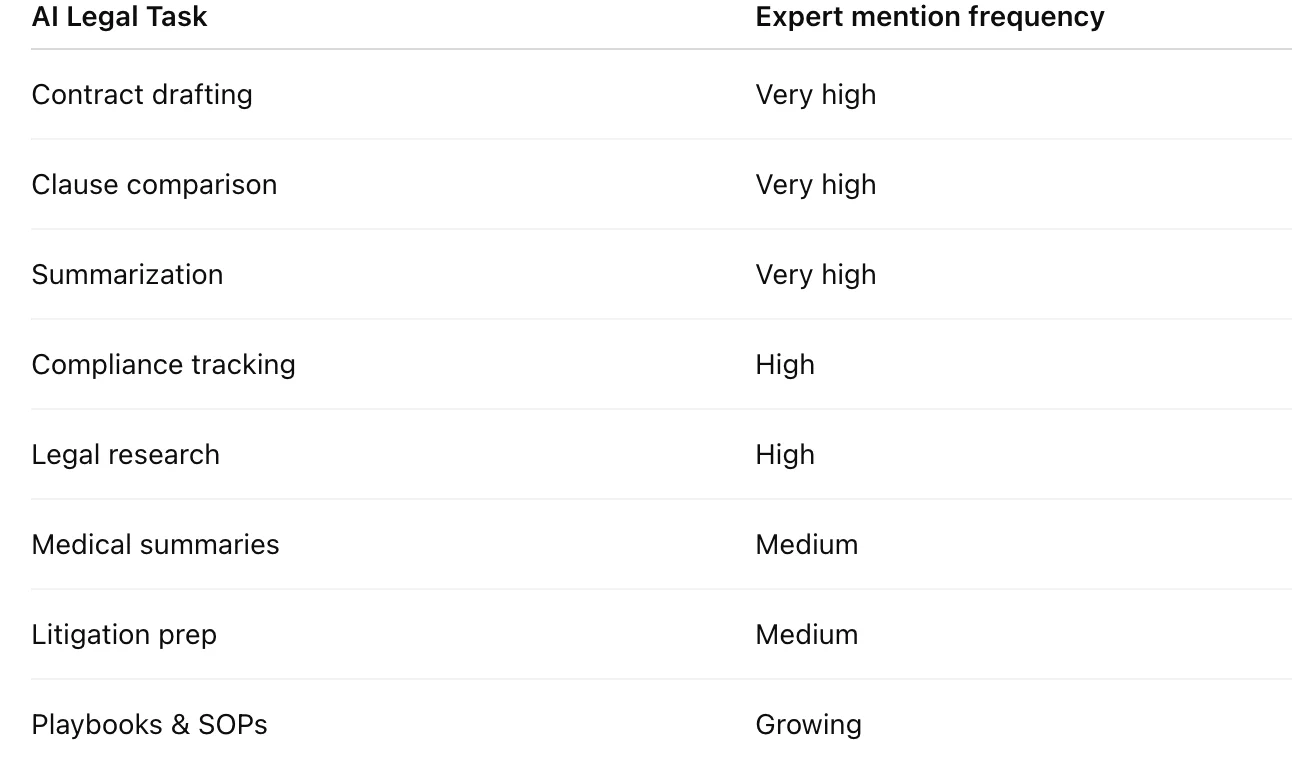
“AI now automates high-volume work like document intake/classification and routine medical-provider follow-ups, work that used to create backlogs and eat up thousands of staff hours.”, according to Angel Reyes, Founder and Managing Partner of Angel Reyes & Associates
How Lawyers Are Using AI legal tools?
✔ Legal Contracts: Drafting NDAs, reviewing agreements, automated redlining, and clause comparisons
✔ Litigation prep: Summarizing depositions, analyzing discovery, drafting interrogatories and complaints
✔ Legal research: Surfacing precedents, outlining motions, summarizing case law
✔ Medical & case records: Organizing files and generating summaries
✔ Regulatory tracking: Monitoring compliance updates and due diligence reviews
✔ Operational & Admin Work Inside Law Firms.: Document intake and classification, Case file organization, Cross-checking multi-document filings, Drafting SOPs and policies, Creating client-friendly legal explainers
How Startups are using AI Legal Tools?
Interestingly, AI Legal tool adoption isn’t limited to attorneys.
Founders, entrepreneurs, startups with no inhouse teams are now using AI legal tools for first-level legal work:
✔ First-pass contract drafting and review
✔ Agreement summarization
✔ Clause comparisons
✔Preparing questions for lawyers
Many also use AI to turn regulations into internal checklists, policies, and playbooks
Curtis:, owner of Banana Thumbnail, says "When I was launching Banana Thumbnail, I used AI to help review our terms of service and privacy policy drafts - saved me probably 8 hours and a few hundred bucks in legal fees"
C. General AI vs. AI Legal Tool
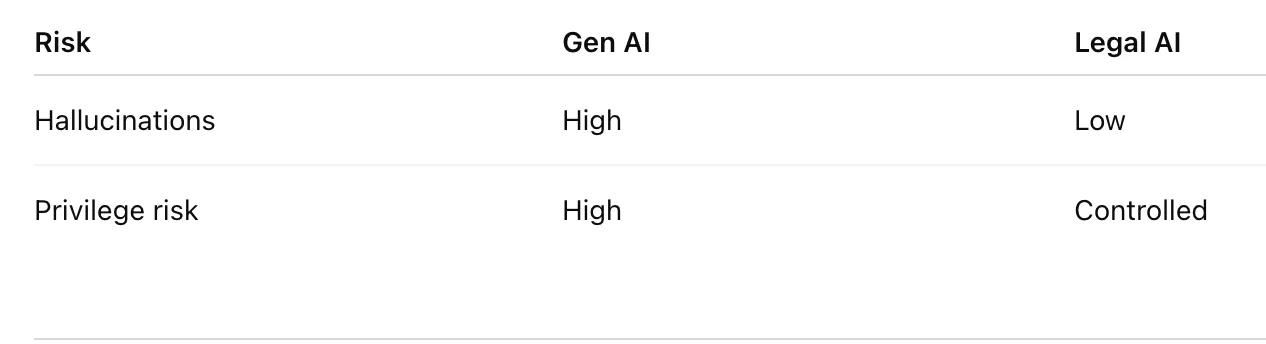
The experts are unanimous: AI Legal Tool is for law and General AI is for marketing, blog posts, and clerical tasks. A specialized legal AI tool is vastly more effective and less risky. General chatbots lack the trained legal understanding, current regulatory databases, and secure architecture necessary for reliable, confidential legal work, says Josh Katz, a CPA at Universal Tax Professionals
Alan Heimlich, President of Heimlich Law in Silicon Valley, adds “A startup who reveals trade secrets via an artificial intelligence interface might inadvertently diminish its competitive advantage or even forfeit the protection of trade secrets”
Furthermore, John Malm, Owner of John J. Malm & Associates Personal Injury Lawyers, notes that while his firm uses general AI for marketing, they pivot to specialized tools for legal research, writing briefs to avoid errors and case hallucinations.
D. What Businesses Evaluate Before Adopting AI Legal Tools
Evaluate the following 6 criteria before subscribing to AI legal tool:
- Data security & confidentiality
- Accuracy + source verification
- Compliance & liability clarity
- Workflow integrations
- Cost vs measurable ROI
- Vendor trust & governance readiness
Here’s a comparison between General AI vs. AI legal tool:
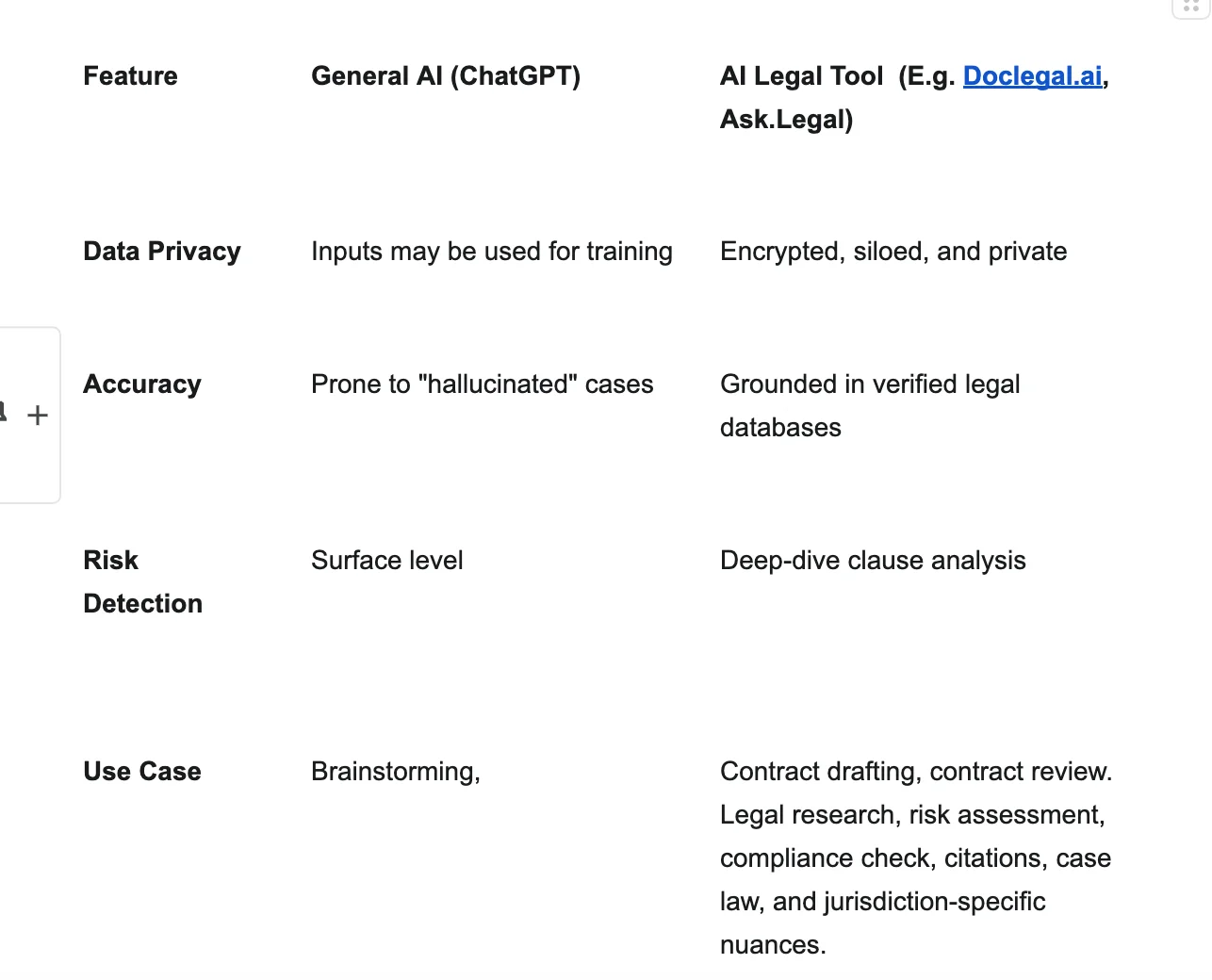
Based on the responses we received from contributors:
✔Legal Professionals Emphasize = Privacy outweighs price.
✔Business Owners Evaluate = implementation practicality alongside legal safeguards
E. The Common Consensus: More Time for Strategic Work with AI Legal Tools
With AI handling routine work, human legal teams can focus on meaningful tasks:
- Rick Elmore, CEO & Founder, Simply Noted, says that AI handles routine work and professionals can now focus on client relationships
- Luca Ziveri, SaidText CSO, says the biggest gains are in summarizing, outlining, and generating structured checklists from messy inputs.
AI is transforming legal work from reactive to strategic. It is enabling professionals to finally work smarter, not just harder.
F. Future Outlook: Where Transformation Is Headed Next
While current efficiency gains are substantial, contributors believe the next wave of AI transformation will move beyond task automation into real-time legal intelligence.
1. Autonomous Draft Iteration
AI systems will soon refine contracts dynamically based on negotiation positions, risk tolerance, and counterparty profiles — reducing redlining cycles.
2. Litigation Copilots
Emerging tools are expected to assist in live litigation strategy by mapping case trajectories, surfacing precedent risks, and modeling opposing arguments.
3. Regulatory Monitoring in Real Time
Instead of periodic compliance reviews, AI will continuously monitor regulatory changes and auto-update policies, contracts, and disclosures.
4. Predictive Risk Detection
Future platforms will flag litigation exposure, indemnity gaps, and enforceability risks before agreements are executed.
5. Integrated Legal-Business Decisioning
Legal AI will increasingly plug into procurement, finance, and sales systems — embedding legal oversight directly into business workflows.
Outlook Summary
(a) The first phase of legal AI transformation has been defined by speed and efficiency.
(b) The next phase will be defined by prediction, autonomy, and embedded legal intelligence across organizational decision-making.
In short, AI is evolving from a productivity assistant into a strategic legal infrastructure layer.
Experience the 80% Efficiency Shift.
Doclegal.ai Free Preview
