
Before You Sign: The AI Tool That Explains Your Contract Clauses

Have you ever stared at a contract, unsure what a clause really means or whether you should sign? You’re not alone. Contracts are filled with dense language and legal jargon that can leave anyone feeling confused. But what if you had a helpful guide to explain things in plain English and highlight what matters most to you?
That’s where DocLegal.ai steps in, transforming how everyday people understand and make decisions about contracts. This guide will show you how AI is transforming the way we interact with contracts.
Common Issues You May Face in Reading Contracts
Common issues people face include:
- Boilerplate language and legal jargon: Standard clauses that seem unimportant but can have big implications.
- Dense language: Contracts are often written in long, complex sentences that can be hard to follow.
- Ambiguous terms: Phrases like “reasonable efforts” or “material breach” that are open to interpretation.
- Hidden risks: Obligations or liabilities buried deep in the document.
Read more about how Contract Review Work Slows You Down. AI-powered tools are built to spot and explain these issues in seconds.
How Generative AI Lends a Hand
First, let’s break down what we mean by “legal tech” in simple terms: technology designed to make legal processes easier. For contracts, this often involves tools that can read, explain, and analyze documents for you.
Generative AI, which is the technology behind chatbots we have grown familiar with, can be trained on thousands of legal documents. DocLegal.AI was trained on a library of 2,800+ documents vetted by legal professionals, so you can generate and review documents with greater trust and clarity.
Here’s what generative AI can do for you:
1. Instant translation from "legalese" to plain English
Simply upload a contract to DocLegal.ai’s Document Review, highlight a confusing clause (like an “indemnity clause” or “force majeure”), and ask, “What does this mean in simple terms?” The AI can provide a clear, concise explanation of the clause's purpose and real-world effect.
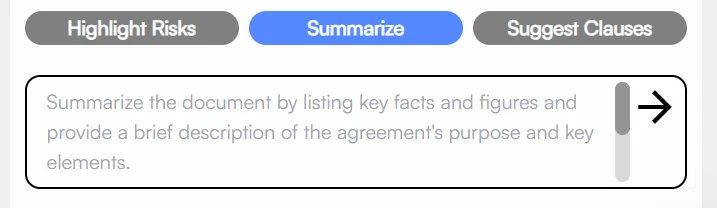
2. Summarizing key points fast
Instead of reading 20 pages, you can get a one-page summary highlighting the essential terms: parties, payment schedules, key deadlines, termination rights, and major obligations. DocLegal.ai has summarize-specific mode, further enhancing its capabilities and ensuring that its responses are precise and contextual. This can aid you to be more fully informed prior to making decisions based on the document.
3. Proactive risk flagging
The AI can scan for clauses that are often problematic, like automatic renewal terms, excessive liability, or unusual confidentiality requirements. DocLegal.ai will alert you with a note like, “This clause may allow the other party to terminate the agreement with only 7 days' notice, which is shorter than standard.”
4. Answering your specific questions
You can ask direct questions about your document: “Is there a penalty if I cancel early?” or “What are my obligations if the project is delayed?” The AI finds the relevant sections and explains them in context.
Read more about The Top 5 Features Every Legal Document Generator Online Should Have.
Seeing AI in Action: A Practical Example
To see this in action, let’s look at a common but complex scenario: a non-compete clause in an employment contract.
Clause:
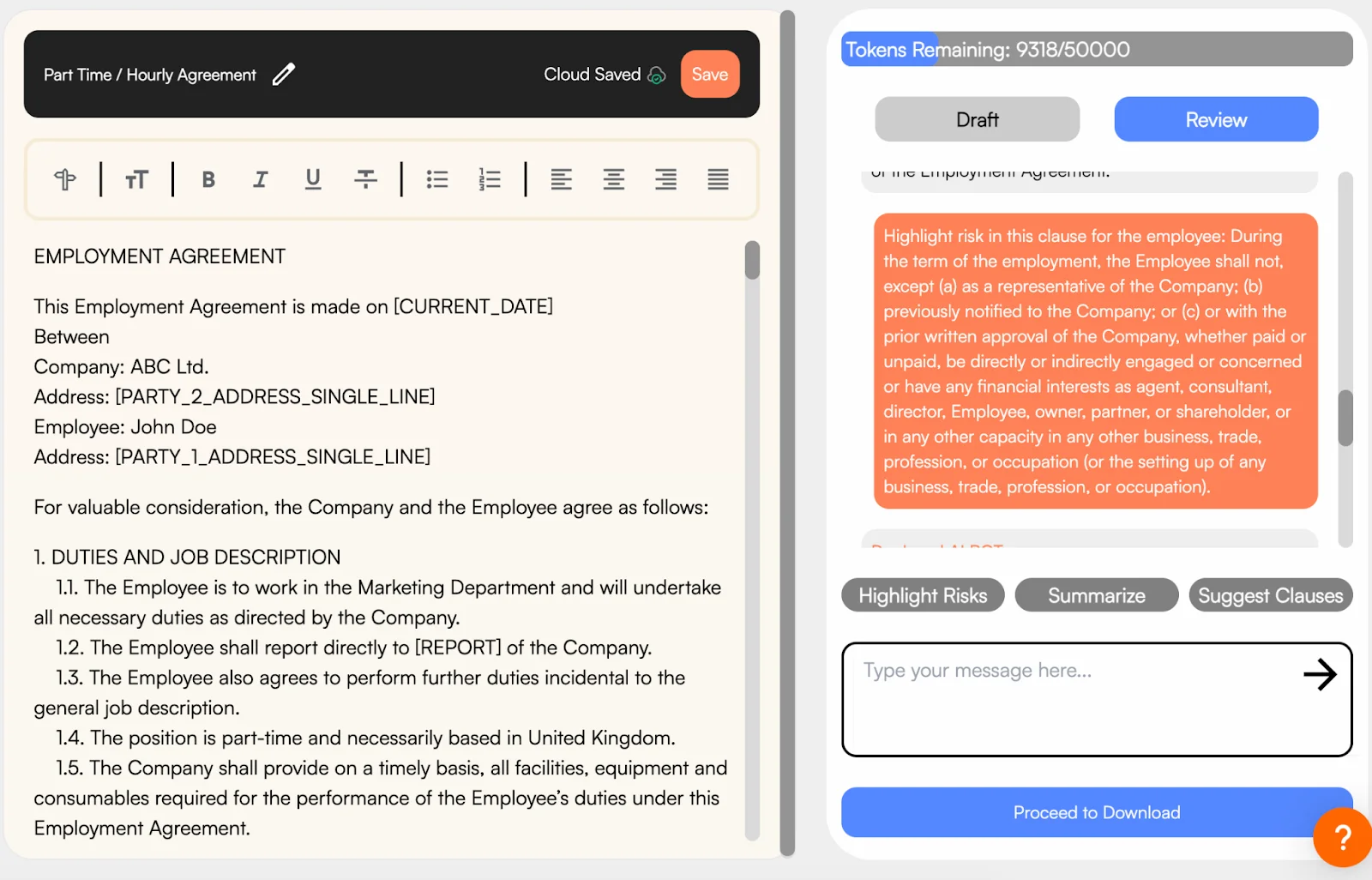
“During the term of the employment, the Employee shall not, except (a) as a representative of the Company; (b) previously notified to the Company; or (c) or with the prior written approval of the Company, whether paid or unpaid, be directly or indirectly engaged or concerned or have any financial interests as agent, consultant, director, Employee, owner, partner, or shareholder, or in any other capacity in any other business, trade, profession, or occupation (or the setting up of any business, trade, profession, or occupation).”
DocLegal.ai’s analysis:
- Broad restriction on outside work – The clause prohibits almost all outside business or employment without prior written approval.
- Ambiguity in scope – Terms like “directly or indirectly engaged” may cover unrelated activities, creating uncertainty.
- Financial interests restriction – Even passive investments could be caught, unless approved.
- Approval discretion – The Company has sole discretion to grant approval, which could unfairly limit the Employee.
- Potential disciplinary consequences – Breach could be considered misconduct, leading to termination or loss of post-termination entitlements.
This example illustrates how AI doesn’t just explain the clause — it flags potential risks, helping you understand the impact and make informed decisions.
How you can act:
Based on DocLegal.ai’s analysis, you can use the platform to propose more balanced alternatives, such as:
- Limit the clause to competitive activities only, so unrelated work or passive investments aren’t restricted.
- Require that the Company exercise approval reasonably, rather than at sole discretion.
- Remove the post-termination entitlements restriction so the Employee’s rights after leaving the company aren’t unfairly limited.
This example illustrates how AI doesn’t just explain the clause — it flags risks and suggests practical changes, helping you negotiate smarter and protect your interests.
Here’s a revised, practical version of the clause:
Revised Non-Compete Clause:
1. Non-Competition Clause
The Employee undertakes and agrees that, during the term of their employment with the Company, they will not engage in any competitive activities that directly conflict with the business interests of the Company. Competitive activities are defined as any actions or endeavors that involve establishing, operating, or participating in a business that offers products or services similar to those provided by the Company, within the geographic area where the Company operates.
The Company agrees to exercise reasonable approval in determining whether an activity constitutes a competitive activity. The Employee may seek prior written consent from the Company for any activity that may potentially fall within the scope of this clause.
This revised clause:
- Limits scope to competitive activities only.
- Requires the Company to exercise reasonable approval, rather than having sole discretion.
- Removes post-termination entitlements and overly broad restrictions, protecting the Employee’s rights.
By using DocLegal.ai, you can not only identify the risks in a clause but also draft safer, more balanced language that protects both parties’ interests.
Decision-making after Understanding
After the AI explains the clauses and flags risks, it can help you:
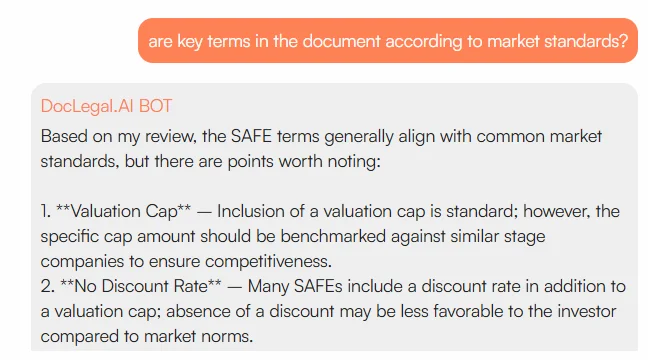
Compare to Standards: Some tools can show how a clause compares to common market standards, letting you know if a term is typical or one-sided.
Taking Control of Your Contracts
Legal technology and generative AI are powerful tools for demystifying the agreements we encounter in business and life. They empower people to move swiftly from the initial “What does this mean?” to the informed “Is this fair?” and finally, to a confident “Should I agree?”
By providing instant clarity and highlighting potential pitfalls, AI tools like DocLegal.ai puts the power of understanding back in your hands, making contract review faster, less intimidating, and more effective for everyone.
Ready to look at your next contract with more confidence? Try DocLegal.ai’s contract generator and reviewer to experience how AI can bring clarity and control to your legal documents.
Read more: How to Manage Documents & Templates for Startups
